book Motion and Biomechanics in Training
Book Details
book Motion and Biomechanics in Training
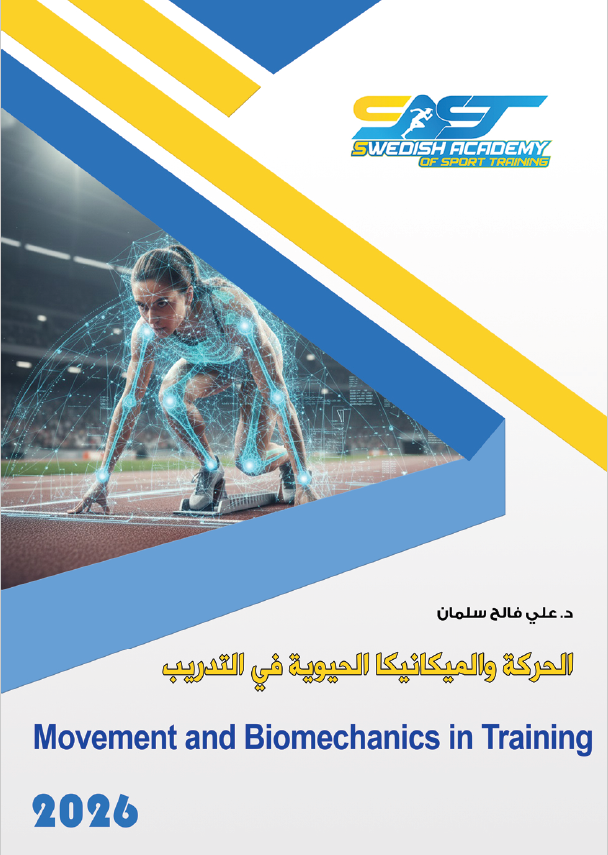
Discover the secrets of sports movement with “Motion and Biomechanics in Training”, accredited by the Swedish Academy of Sport Training (SAST). Authored by Dr. Ali Faleh Salman, this guide offers a solid scientific foundation in biomechanics, linking theory to practice to reduce injuries and improve performance efficiency.
Description
This book is intended for both sports coaches and aspiring practitioners who wish to elevate sports training from mere effort to a precise science based on physical, anatomical, and physiological principles. The book serves as a bridge connecting theoretical knowledge of movement sciences with practical application in the sports field.
Objective and Main Content
The book aims to provide you with a solid scientific foundation on the basic concepts of movement and biomechanics in a simple and clear way. Through it, you will be able to understand how muscles generate force, how to reduce the risk of injury, and how to enhance performance efficiency.
The book covers fundamental scientific concepts, including:
The Concept of Motion: Definition of motion, its types (linear, rotational, general), and the biological and mechanical factors influencing it, such as force, mass, friction, and gravity.
Introduction to Biomechanics: Definition of this science, which applies mechanical principles to the human body, its importance in improving performance, preventing injuries, and designing sports equipment. It also includes its main branches, such as statics and dynamics (kinematics and kinetics).
Principles of Human Movement:
The skeleton as a framework providing support, protection, and levers for movement.
Joints and their types (fixed, semi-movable, movable) and their role in performance.
Muscles and patterns of muscle contraction (concentric, eccentric, isometric).
The concept of force and torque and their role in producing movement and rotation.
The kinetic chain (open and closed), balance, and stability.
Why This Book is Essential for Coaches
Bridging theory and practice: Enables coaches to analyze performance, identify strengths and weaknesses, and correct technical errors.
Enhancing performance and preventing injuries: Understanding rotational laws helps correct postures and optimally distribute forces, reducing excessive stress on joints.
Designing scientific training programs: Transforms training into a precise scientific process based on data analysis and physical laws.